


For very early products, using your payment processor's dashboard or transaction history as the source of truth can feel practical. You can see payments, refunds, disputes, and payouts in one place, and your team can move fast without adding another system.
The problem starts when your product stops being a simple payment flow and becomes a financial system. Take Josh, for example, a customer of a digital wallet app. He tops up his wallet, a part of his balance is reserved against a pending transaction, a fee is deducted, and a refund lands a week later through a different rail. Suddenly, the processor dashboard and your product disagree about what the customer actually has.
At that point, the question changes from "Did the processor move money?" to "What does our product believe every customer, merchant, wallet, account, business unit, or internal balance owns at this exact moment?"
That second question is a ledger question. So when should you actually separate the ledger from your payment processor?
The short answer
Separate your ledger from your payment processor when your product needs an independent, product-owned system of record for balances, money movement, and reconciliation that is bigger than one payment provider.
If any of these is true for your product, you have crossed into ledger territory:
- You store balances for customers, merchants, or internal accounts.
- You handle refunds, fees, credits, or other internal money movements.
- You reconcile against more than one processor or payment rail.
- You are adding, or planning to add, a second processor or payment method.
If none of these is true and your product only records simple one-way payments, your processor's transaction history may still be enough for now.
What payment processors are good at
Payment processors solve a hard, valuable part of financial infrastructure: connecting your product to payment rails.
They typically help you:
- Accept payments from customers.
- Send payouts to users, merchants, or partners.
- Handle refunds, disputes, and chargebacks.
- Receive settlement reports.
- Track processor-level transaction statuses.
- Reduce the operational burden of connecting directly to banks, card networks, or local payment methods.
You usually do not want to rebuild that unless you have a very strong reason. But the processor's record is built around the processor's job: payment execution. A product ledger has a different job: financial truth inside your product.
What a product ledger is responsible for
A ledger tracks financial state in a way your product, support team, finance team, and engineering team can trust.
A strong product ledger should answer:
- How much does this customer currently have available?
- How much is reserved, pending, or in transit?
- Which internal account owns this balance?
- Which event created this balance movement?
- What fees were earned, deducted, reversed, or refunded?
- What happened before and after a failed payment?
- Which external payment event does this internal entry relate to?
- What should finance reconcile against the bank, processor, or wallet statement?
It is not just a transactions table. It is the accounting layer for your product's money movement. For a deeper take on how this is structured, see Designing Your Ledger Architecture with Blnk and Best Practices for Building with the Blnk Ledger.
Why teams start with the processor as their source of truth
Most teams do this for understandable reasons. Early on the flow is simple: a customer pays, the processor confirms, the product unlocks access or credits a wallet, and finance checks processor reports when needed.
The processor already provides transaction IDs, statuses, timestamps, customer references, and settlement reports. For a simple product, that may be enough.
Starting this way is not the mistake. The mistake is staying this way after your product's financial logic becomes more complex than the processor's transaction model.
Signs you should separate your ledger from your processor
1. You have stored balances or wallets
If users can hold a balance in your product, you need a ledger that is independent from the processor.
A processor can confirm a pay-in succeeded. It cannot represent what that money means inside your system afterwards:
- A top-up arrives.
- Part of the balance becomes available, part is reserved for a transaction.
- A fee is deducted.
- A refund or reversal happens later.
- The customer withdraws through a different provider.
The processor only sees the external events it handled. Your ledger needs to track every internal state change between them. (For a hands-on view of this pattern, see How to Build a Wallet with Stripe & Blnk.)
2. You move money internally before or after external settlement
Many financial products have internal movement that does not map cleanly to a processor transaction:
- Escrow holds.
- Marketplace split payments.
- Merchant settlements.
- Loan disbursement and repayment allocation. (See How to Build Loan Disbursement, Interest, and Repayments with Blnk.)
- Treasury movements between internal accounts.
- Credits, rewards, bonuses, or adjustments.
- Wallet-to-wallet transfers.
If money can move inside your product without a new processor charge or payout, the processor cannot be your complete source of truth.
3. You use more than one processor or payment rail
A single processor may work well for one market or one payment method. As you grow you may add cards, bank transfers, mobile money, direct debit, stablecoins, local PSPs, or a backup processor for redundancy.
Once that happens, no single processor can be your source of financial truth. Each provider has its own transaction model, statuses, fees, settlement timing, and failure behaviour. Your ledger should normalize the product's financial truth across all of them.
The processor answers: "What happened on this rail?"
The ledger answers: "What happened in our product?"
4. You need reconciliation and audit controls
Reconciliation and auditability are two sides of the same problem: knowing what happened, when, and whether it matches reality. When product state is scattered across processor dashboards, app database rows, spreadsheets, and finance reports, both break down. Reconciliation becomes a support and finance fire drill, and your audit trail depends on whoever can read the right logs at the right moment.
A separate ledger gives you one place to compare internal entries against processor reports, bank statements, wallet statements, and settlement files. It is also where you answer who or what created an entry, whether it was reversed, and whether balances can be reconstructed from history. (See How to Reconcile Stripe Transactions with Your Blnk Ledger and How to Handle Idempotency in Your Financial App Using the Blnk Ledger.)
5. Your support team needs to explain balances and history
Customers do not ask processor-shaped questions. They ask:
- Why is my balance lower than expected?
- Why is this money pending?
- Why did this refund not restore my available balance?
- Why was my payout less than the sale amount?
- Why was a fee deducted twice?
If your team cannot answer these from your own ledger, support depends too heavily on processor dashboards and engineering. A product-owned ledger gives support and ops a clear audit trail.
6. You need pending, available, reserved, and failed states
Processor statuses are usually not enough. A card payment may succeed, but the value may not be available for withdrawal until fraud checks or settlement clear. A payout may be initiated, but the user's available balance should already be reduced while it is pending. A refund may have several effects on customer, merchant, platform revenue, and processor fees that do not all happen at once. These states belong in your ledger because they define what your product believes and allows.
When it is okay to stay on the processor for now
Not every product needs to separate immediately. You may be fine using your processor as the main financial record if:
- You only accept simple, one-way payments.
- You do not hold balances, split funds, or move money internally.
- You use one processor and one payment flow.
- Finance can reconcile comfortably from processor reports.
- Support rarely needs balance-level investigation.
Even then, design so that a ledger can be added later without rewriting your payment architecture.
A decision framework
Ask these questions in order. If you answer yes to two or more, you are past the point where the processor can be your source of truth.
What separation should look like
A clean architecture usually looks like:
- Your product receives a user action: top-up, purchase, withdrawal, refund, transfer.
- Your backend creates an internal transaction reference.
- The processor executes the external money movement where needed.
- Processor events arrive via webhooks or reports.
- Your ledger records the financial effect using your own balances and accounts.
- Reconciliation compares ledger records against processor, bank, or wallet statements.
The key rule: your product should never depend on the processor dashboard to know what a customer balance is.
The next two examples show what this looks like in practice, from a simple case to a more layered one: a wallet top-up where one external payment maps to internal state changes inside a single account, and a marketplace payout where one buyer payment produces several internal transactions across different accounts at once.
Example: wallet top-up
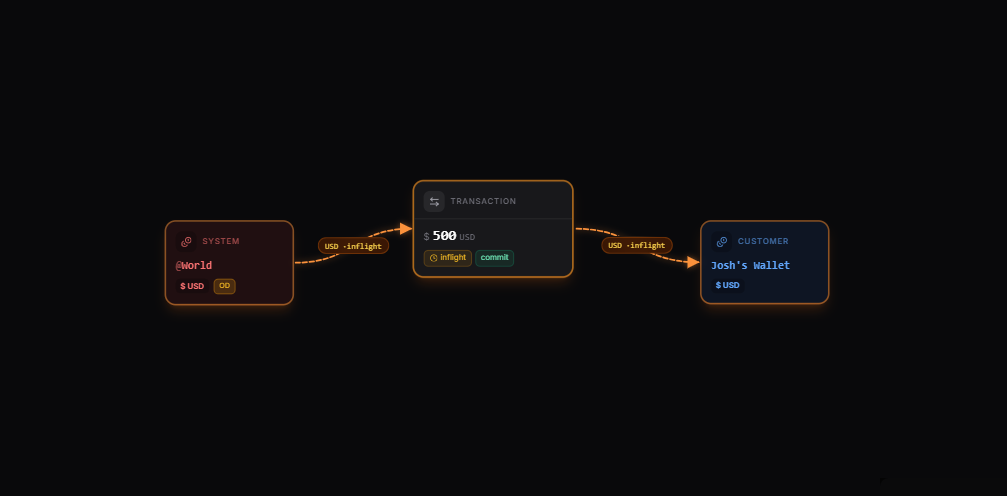
Take Josh's wallet top-up from the intro.
The processor tells you: payment initiated, succeeded or failed, processor transaction ID, amount charged, settlement status.
Your ledger tells you: which customer balance was credited, whether funds are pending or available, which internal account received value, which fees applied, which ledger transaction maps to the processor transaction, and what reversal happens on refund or dispute.
Both records matter. They just should not be the same record.
Example: marketplace payout
A single buyer payment can produce several financial effects in one go: gross value recorded by the platform, a net amount earned by the seller, a platform fee, a portion held in escrow pending fulfilment, and a payout that lands later through a processor. The processor only sees the initial charge and the later payout. Your ledger has to show the full movement of value between buyer, seller, platform revenue, pending balances, and payout accounts. This is where separating the ledger stops being optional.
.png)
Separating too late, or too early
Separating too late tends to show up gradually: balance bugs that take engineering to explain, refunds that need manual correction, finance reports that drift between systems, and processor migrations that quietly become risky because history is tied to one provider. Most teams do not notice the cost until it has been compounding for a while.
Separating too early looks like:
- Building account structures, balance types, transaction types, reversal logic, idempotency rules, and reconciliation flows before you have a product flow that needs them.
- Adding complexity that slows shipping for a flow that could have stayed on the processor for now.
The goal is not to add infrastructure for its own sake. The goal is to stop payment execution from doubling as financial truth once the product has outgrown that model.
How Blnk fits
Blnk is the ledger layer that sits beside your processors, banks, wallets, and internal systems. It is not a replacement for any of them. It is the source of truth for balances, money movement, and reconciliation inside your product, independent of any single processor.
Processors move money. Blnk helps you track what that movement means inside your product.
Practical migration steps
If the processor is currently your source of truth, you do not need to change everything at once.
1. Map your money movement
List every place money enters, leaves, or moves: pay-ins, payouts, refunds, fees, internal transfers, holds and releases, adjustments, failed transactions, manual corrections.
2. Define your accounts and balances
Decide what your product needs to track: customer available balance, customer pending balance, merchant payable balance, platform fee balance, settlement clearing balance, processor receivable or payable balance. Do not copy another company's chart blindly.
3. Use stable, idempotent references
Every ledger transaction should be traceable to the product event and external payment event that caused it: product transaction ID, processor transaction ID, webhook event ID, customer ID, settlement report reference. If you are using Blnk, this is already enforced at the ledger level: each transaction requires a unique reference (a transaction identifier you choose), and retries with the same reference cannot produce duplicate credits or debits. Your job is to pick a stable, meaningful reference per logical event and reuse it on retry across webhooks, timeouts, and repeated user actions.
4. Reconcile regularly
Do not wait until month-end to find mismatches. Compare your ledger against processor reports, bank statements, wallet statements, and settlement files on a regular cadence. Reconciliation is a product reliability task, not just an accounting one.
Conclusion
Payment processors are the right tool for moving money. They are the wrong tool for deciding what money means inside your product. The moment your product needs to know who owns what, why it changed, whether it is available, and how it reconciles, you have crossed into ledger territory. The teams that struggle later are almost always the ones who treated "the processor said so" as financial truth for one product cycle too many.
The practical move is small: pick one balance, one money-movement flow, or one reconciliation gap that is already costing you time, and put it behind a real ledger. Everything else gets easier from there.
The fastest next step is Blnk Cloud, hosted ledger infrastructure you can evaluate today. If you want full control of the deployment, Blnk Core is the open-source engine that powers it. For a second pair of eyes on your migration, architecture, or implementation, book a Pro Support conversation.

